
I loved him so much that I begged him to go...
The Story of Charu Aggarwal
Based in New Delhi, India
Rahul and I got married in 2009 after patiently waiting a long time to convince my parents. It took a while- and understandably so- given that Rahul lives with a condition that affects his movements and muscle control, something my parents couldn't see beyond in the beginning.
It was Rahul’s efforts and character that finally won them over. For the next few years we were in bliss and we decided to expand our happiness by creating a new life together.
I got pregnant in 2013.
My pregnancy was textbook perfect. I was hale and hearty, full of energy, no morning sickness, no nausea, nothing. Just a happy kicking baby inside me. All the tests and ultrasounds were perfect and we, along with our extended families were really looking forward to the new phase of our lives.
Nine months later, my labor pains started just a day before the due date. After 24 hours, we had a healthy looking, pink baby in our arms. It was a boy, weighing 3.8 kilograms, a healthy birth weight by all standards.
We named him Rushil- the charming one.
Celebrations began soon after his birth. It was almost midnight so my mother decided to relieve Rahul and stay at the hospital. It had been a long day for him too. He had been in the labor room throughout. As most babies do, Rushil had the colostrum, the first feed of mother’s milk, and slept blissfully for the next few hours.
We had to wake him up to feed him again. He fed a little and vomited something green a couple of times. The nurse told us that it was just acid reflux, something very normal for newborns. She took him to the NICU (Neonatal ICU) to clean his stomach and for general observation until he was comfortable.
A couple of hours later, he was brought to me. They had cleaned his stomach and he seemed absolutely calm. I breastfed him, only to see him vomit something green once more. The doctor and the nurses told me again that it was all normal and took him back to the NICU. We were also advised to stay in the hospital for one more day for observation.
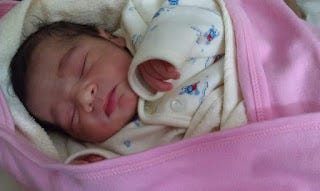 |
| Our little Rushil soon after he was born |
Soon I was called to the NICU to feed him and to offer him skin-to-skin contact. Rushil had already started exploring his new surroundings. Rahul kept peeping into the NICU, missing being a part of these moments.
All seemed normal until, on one such trip to the NICU, Rahul sensed something amiss. It was late evening and the NICU in-charge had been called back during her off duty hours. She calmly told us to wait in the room, and assured us that she would come to us with updates as soon as she could.
A very anxious half an hour later, she walked into our room and informed us that there was indeed something wrong with our baby. They couldn’t be sure what exactly it was yet, but knew that he was losing blood. By then he had become very pale. They suspected a bleed in the brain.
She assured us that she was doing all she could to find the best solution for Rushil. She had already consulted her seniors and experts at other hospitals.
'“Maybe it could be something as simple as surgically finding the source of blood leak and fixing it,” she said gently. She requested for our trust and patience.
We nodded.
At around 10.30 p.m. that night, his tiny frame was taken for an ultrasound, followed by a CT scan. All the reports came out normal. Yet, watching our tiny baby being pricked every few hours was excruciating. The doctors had to keep a check on various parameters including his haemoglobin levels.
It kept dropping.
The neo-natal paediatrician told us to rest while she tested Rushil for possible causes. Throughout the night we felt her reassuring and supportive presence.
By dawn, Rushil’s stomach had begun to distent. He shrieked in pain if anyone so much as tried to touch his stomach.
Our doctor had already requested the pediatric surgeon to come and examine him. The surgeon was reluctant at first and dismissed the concern, saying all that was needed was for the baby to pass urine and meconium.
But after our doctor’s insistence, he came.
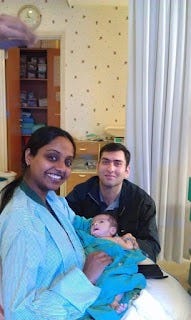 |
| This is us. |
The surgeon had one look at Rushil and said he would have to perform an exploratory surgery as soon as possible to find out the root cause. We informed both of our parents who rushed to the hospital to be by our side.
Our son was just 3 days old when he had his first surgery- tiny, pale and fragile. Needless to say, we were both nervous wrecks.
Our prayers were focused on a quick diagnosis and treatment for our child. We longed to take him home, to spend sleepless nights with him, not waiting for him.
A few hours of tears and tension later, the surgeon walked out of the operation theatre with a small bowl containing a sausage like thing in his hand. We had the verdict: Rushil had a rare and severe congenital deformity called Apple peel deformity.
Usually there is a web of blood vessels supplying blood to the intestines, in our case, our son had only one such vessel. Even though his small intestine was fully formed, the only blood vessel supplying to it had become twisted resulting in hampered blood supply to the intestine. His blood had started flowing inside his intestine turning it gangrenous. More than 70% of his small intestine was removed in the surgery. The only positive news was that his colon, which helps the body absorb liquids was intact.
The surgeon wasn’t sure if Rushil could digest my milk on his own or would need pre-digested formula once he recovered from the surgery. What he was sure about was that Rushil would require special pre-digested food throughout his life. His body was not capable of digesting anything on its own.
That evening was when the reality really hit us- we would never have a ‘normal child’. Feeding tubes would spend more time with him than I ever could. He would visit hospitals more than a school. Complications would be more common than comfort.
We broke down, even as our neonatologist kept giving us hope. She was busy doing research, contacting specialists in other parts of the world, trying to find the best possible solution for us.
“Let’s wait and see how he recovers from the surgery,” she said. She was looking into every option including a transplant. She also convinced the surgeon with her findings that no formula can replace the goodness of mother’s milk when it comes to healing after surgery.
Even though I had been discharged from the hospital, we only went home at night. Every minute that we were allowed in the NICU with Rushil was spent with him. The rest of the day was either waiting or attending appointments with various doctors. I was allowed to give him breast milk only after a week, when his stitches had healed and the surgeon thought it was safe.
He took the feed hungrily but, unfortunately, his stomach bloated almost instantly after drinking. The surgeon rushed him into the operating theatre and made an incision in his tiny stomach. The same green bile started oozing out.
Once again, a series of inconclusive tests followed. The surgeon suspected that his internal stitches had given way. He wanted to open Rushil up again.
We were wary of it. He was just 16 days old.
So much had happened, all too fast to process. A second surgery seemed scary. We had briefly celebrated his birth just a week and a half ago, and here we were, a few days later, not knowing what to do with him.
During this time, we had taken a second, third, and fourth opinion. The common opinion was for us to prepare ourselves to be caretakers of a child in a near-vegetative state, with pipes going in and out of his body for as long as he lived.
Or to prepare for the worst.
The choice was ours.
The questions haunted us. What were we looking at in the long run? Did a baby deserve to go through physical agony, and multiple surgeries when the doctors were unsure of the outcome?
We deeply loved our son. We wanted him.
But at what cost?
What was the right call to make?
Clarity came when one of the doctors said that his only aim was to keep Rushil alive. Whether he would eat all his life or not was secondary to him.
In that moment, our choice became clear.
We would not take such a selfish decision.
We did not want our child to turn into a vegetable. Our love for him was greater than parental ego that demands we do anything to keep a child alive.
We did not want him to suffer just for our need for him.
We could not focus on keeping him alive, if he did not have a life worth living.
By then, we knew that he would not grow normally. He would need constant medical intervention all his life, and yet he would never lead a healthy life.
Our decision was made.
When we went to our surgeon, he was rather nervous. We told him, in our calmest possible voice, that our prime objective was to relieve Rushil of his pain. If the second surgery he suggested, would help in that, then we were ready for it.
We also conveyed that we trusted his judgement. And wanted him to know that if he faced a difficult choice during surgery, then we would not question the choice he made.
We conveyed our faith to him. And also our painful decision.
We wanted a pain-free Rushil.
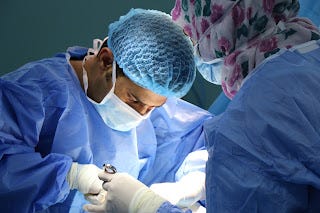
The second surgery revealed that not only his stitches but most of the small intestine was destroyed. His stomach had become an open pit.
Nothing was left, neither his intestine nor any hope. The doctor stitched back whatever little was left.
We were told to focus on palliative care. There was no way of saving him.
Our focus became making our child’s death as pain-free as possible.
Watching him with all those tubes and wires was both hard and necessary. It made acceptance of our fate a bit easier for us. He was fed intravenously to provide whatever little nourishment his body could absorb.
The nurses would constantly be with him. The doctor made more rounds than necessary. By now we had formed a personal relationship with the hospital staff. He had so many mothers taking care of him. Sometimes, we would all cry together. They would take turns holding him in our absence.
For someone so tiny, he had impacted a lot of us.
As Rushil’s condition deteriorated, we started noticing it affecting not only us but also the staff. This had been a forty-day long journey for all of us by now.
Forty days that taught us much more than we wanted to learn in our entire lifetime.
Rahul and me decided to take our baby home. We wanted him where he belonged, even if for a few hours. No one could predict when he would eventually go but everyone agreed that he deserved to be home.
Our wish of taking our newborn home was finally being fulfilled.
The doctor warned us about the difficulties we would face at home. Both, emotionally and physically. Things would be erratic, unpredictable and draining, for all of us. The lack of machinery and additional hands supporting us would probably take a big toll.
We told her we were ready.
She then prepared us by explaining what to expect: Rushil would literally starve to death. This meant that he would cry a lot, both due to hunger and pain. His throat would be dry at all times.
Then one by one, his organs would start failing, in what order could not be ascertained and then finally he would be relieved of all pain .
The next few days were the longest and the shortest days of our lives.
We had to make the most of the time we had. Dressing him in cute outfits, long conversations, and looking into his eyes full of love- all made the painful times worth it.
Sometimes, even through his hunger and dehydration, he would smile at us and respond in his own sweet little baby ways. I had not known helplessness in this way till I had to hold his wailing, starving body.
There was nothing else we could do.
We hoped that our love was some sort of a balm for him.
He would eventually get tired and sleep, only to be fed a few sips every 20 minutes, just to keep his throat from drying. 20 minutes is the time you would finish watching a TED talk, or clear your work space or think about what to cook for dinner.
We were exhausted.
The milk would go in through the mouth and come straight out from the bottom, like pouring something through a pipe. This routine continued for the next few days. 24x7. I did not have as much milk supply for the 20-minute cycle so we topped it up with formula.
His liver was first to give way. He developed jaundice.
Even though his yellow eyes still conveyed pure love, ours started betraying him. We now looked at him not only with love but also with a combination of despair, pleading, and resignation.
Slowly we started admitting to him that we were both helpless and tired. And maybe even ready to let him go. His suffering was far greater than our exhaustion but it did not have to be elongated anymore.
We would kiss him while howling, and place his tiny frame on our chest, close to our hearts. His body lacked the energy to move even an arm on its own now, and yet he would look at us with the purest love we had ever known. He gave us the sweetest smiles, like he wanted us to know the highest form of love without saying a word.
Gradually his schedule started getting more unpredictable. Either he would not sleep or he would not wake up, sometimes even for 12 hours. The doctor told us that this meant his end was near. We were still singing to him, dressing him up and enjoying the little time we had together as a trio, but now we were checking if he was still breathing every now and then.
Then, on a Sunday afternoon, we noticed his breathing was more laboured than usual. A phone call to the doctor revealed that this meant his lungs were beginning to fail. Most probably, they had a fluid build-up. She proposed sending an instrument that could help him breathe easier at home.
While we waited for the machine to arrive, Rahul decided to hold him while I took a quick shower. I saw only Rahul’s back, and his shoulders slightly moving, on the balcony as I rubbed my hair dry. I walked towards him and heard a sobbing father begging his son to go. He said he had nothing more to offer. I rushed to them and embraced them both.
Our little family was so perfect right now, and yet so imperfect. We all deeply loved each other, yet we were all in our own version of pain. We tried to support each other, yet we were alone in what we felt. We wanted our son, but we kept begging him to go.
Life had been unfair.
I took Rushil in my arms, wanting to feel his little body as close to me as possible. His little frame that was created inside of me, the dreams that we had mentally shared, the storybooks that I wanted to read to him… all felt like betrayals.
Almost like he could telepathically hear my thoughts, he opened his eyes and looked at me. As if he could not bear my pain anymore, he took three laboured breaths and then stopped breathing completely.
Our son was gone.
He had left us and this world that had nothing to offer him. We held on to his lifeless body till panic finally set in. We then rushed to the hospital, half in hope and half knowing that we wanted the hospital staff to get a chance to say their goodbyes to him.
Our charming one had charmed his way into so many hearts. There were so many wet eyes in the hospital that day.
In his short life, Rushil had not only made us parents, he had also helped us experience various forms and magnitudes of love. He had made us go through our worst fears and helped us realise that life still goes on.
He made us grateful in ways we would never outgrow.
Both Rahul and me had a lot to deal with. We were sad, angry, helpless and, also relieved. There was so much we had lost that it seemed natural to even lose ourselves. It took us more than a year to get used to the emotional pain, I wouldn’t say get over it, because how can a parent ever get over their child!
We had to relearn how to live, this time with a constant emotional pain. We grieved, we cried, and we healed. We were sure that we only wanted to focus on ourselves. A lot of people around us wanted us to behave like our child was never born, they got uncomfortable when we talked about Rushil. ‘Have another one’ was the most repeated, and the most insensitive advice we got from multiple sources.
We had support, yet in many ways we were all alone.
After about one and a half years we both decided to go back to the same doctors and talk about having a second child. Those doctors had been so supportive and transparent that we could only trust them now.
Soon, we were pregnant with our second one. This pregnancy was completely opposite of my first; I was anxious and sick all the time. I had acidity, vomiting, nausea...the works. We were doing several extra detailed tests and our pregnancy was being monitored by a genetic expert this time. Every day of the pregnancy I had to remind myself that we couldn’t be unlucky twice.
I had medical science backing me up because even though the condition Rushil had was genetic, it rarely did happen with the same set of parents twice.
Two years and some months later, Rahul and me were in the same hospital with almost the same staff, going through labor. Aseem was born the next day. He looked so much like his elder brother.
He is 3 years old now and is the naughtiest child we have ever come across. Our home is fuller, louder and life is taking shape. In him, we have found laughter, lightness, and joy again. He seems to be here to receive everything that Rushil gave us- our love, attention and blessings.
Every day we thank our Rusha for coming back to us.
And every day we move forward- with love, and with gratitude.
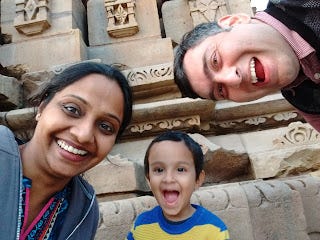 |
| Aseem, Rahul and Charu in 2018 |
We decided to share our story because we wanted the world to know that there is pain, but there is always hope. It just depends on what we focus on. We want to thank the medical staff who took care of us and made us trust humanity. We want to thank all our family and friends for being a part of our journey in their own ways and helping us heal. We want to thank you for reading and humbly hope that our story will help you or your loved one in some way. Like they said, a single thread of hope is still stronger than an entire rope of doubts.
This story was first published in 2018. Aseem is now 11. He has grown into a sensitive and charming boy. He continues to be ‘slightly’ naughty.
Rushil is also present in our lives every day- in the pictures on our walls, in celebrations through the year, and in a special place in our hearts.


No comments:
Post a Comment